
Those Eyes…
How Bette Davis's most irregular feature became the most powerful instrument in the history of the close-up — and changed forever what the camera was for.

M. SEBASTIAN ARAUJO · THE MAGPIE CHRONICLES*
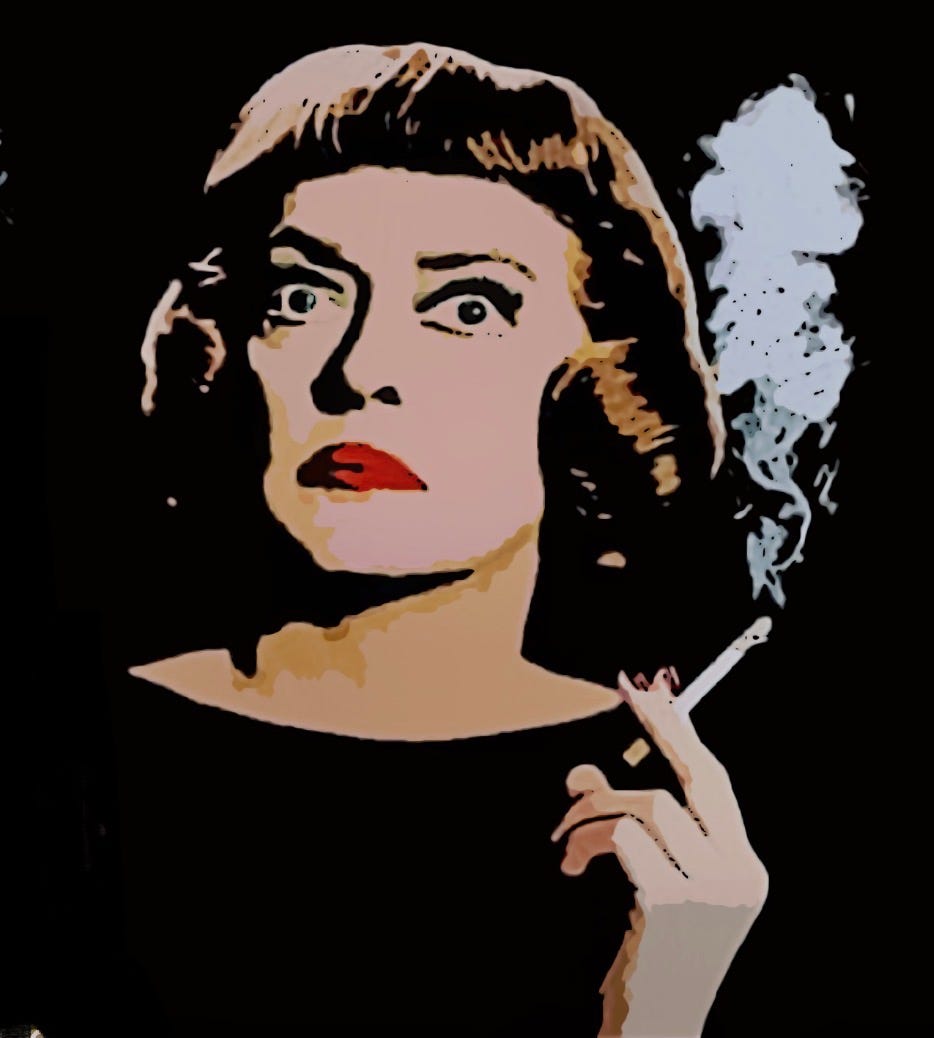
This one is for my friend Patti who has Bette Davis eyes…
FOUR words saved her career.
In 1931, after a string of failed films and a studio that had already decided she was not what they were looking for, cinematographer Karl Freund walked off the set of Bad Sister and told Universal Pictures something that stopped the conversation cold. He had been watching her through the lens. He had seen what the executives in their offices had not.
“Davis has nice eyes.”
That was all. Four words, offered quietly, by a man who understood what the camera could do with the right face. Her contract was renewed. The history of film shifted — not with a fanfare, but with a sentence.
Those eyes. Lake-water blue, appearing hazel on black-and-white film. Wide and slightly protuberant — too wide, too protuberant, her studio kept telling her, as if there were a correct size for a thing that looked the way hers looked. They did not belong to the carefully curated glamour of the golden age. They were not Garbo’s, cool and remote as Nordic stone. They were not Crawford’s, which were knowing and armored. Davis’s eyes were something rawer and stranger: they looked at you as if they were actually looking. As if there were someone fully alive behind them, making decisions in real time, feeling things the scene had not yet caught up to.
Hollywood wanted her pretty and manageable.
She was neither, and her eyes were the first place you could see it.
The critics noticed, even when they couldn’t quite decide what to do with what they were seeing. In 1936, the novelist Graham Greene — not a man given to easy praise — paused his review of a Davis picture to account for the specific quality of her presence. It stopped him the way a face on a train will stop you: the sense that something real is happening behind it.
“The pale ash-blond hair, the popping, neurotic eyes, a kind of corrupt and phosphorescent prettiness. I would rather watch Miss Davis than any number of competent pictures.”— Graham Greene, Film Critic and Novelist,1936
Corrupt and phosphorescent prettiness. It is one of the finest descriptions ever written of a screen presence, and it was provoked entirely by those eyes. Greene understood something that took the studio system another decade to fully absorb: that what Davis had was not beauty as Hollywood had defined it, but something more unsettling and more durable. A face that generated its own light. Eyes that gave off energy rather than simply receiving it.
He was not alone in sensing that she was something outside the ordinary categories. A year earlier, the critic Eileen Arbuthnot Robertson had watched Davis in Dangerous and written about her with an urgency that suggested she had witnessed something she couldn’t fully explain.
EILEEN ARBUTHNOT ROBERTSON, FILM CRITIC, 1935
Corrupt and phosphorescent prettiness. a GORGEOUS way to describe anyonE.IT is one of the finest descriptions ever written of a screen presence, and it was provoked entirely by those eyes. Greene understood something that took the others some time.A year earlier, the critic Eileen Arbuthnot Robertson had watched Davis in Dangerous and written about her with an urgency that suggested she got it but only slightly “I think Bette Davis would probably have been burned as a witch if she had lived two or three hundred years ago. She gives the curious feeling of being charged with power which can find no ordinary outlet.”— Eileen Arbuthnot Robertson, Film Critic,1935
And then there is the scene. If you have never seen Bette Davis work in close-up, I want you to watch the final sequence of Dark Victory, made in 1939. She plays Judith Traherne, a young woman dying of a brain tumor who has sent her husband away so he will not have to watch what is coming. She knows. The blindness that signals the end has already begun. She is alone in the house with her friend, climbing the stairs, and the light is going out.
Watch what she does. She does not perform blindness — does not roll her eyes or glaze them or signal the approaching dark to the back row. Instead she goes still. The eyes remain wide open, looking forward, and the entire performance moves inward. What you are watching, in close-up, is a woman deciding how to die. Not the fact of it — the decision of it. The choice to meet it with grace rather than terror, to send her husband away with the gift of not having seen this. The camera comes close and her eyes hold everything: the grief, the love, the fear she will not show, and underneath all of it, something that looks almost like peace. She does not speak it. She does not gesture toward it. It is simply there, in her eyes, for anyone patient enough to look.
That is what she changed. Before Davis, the close-up in Hollywood was largely a tool of adoration — a way of presenting the face as an object of beauty, curated and lit for maximum appeal. She transformed it into something else entirely: a tool of interiority. Evidence of consciousness. The suggestion that behind the face, something was happening that the face could only partially report — and that the most important part of the performance was precisely the part you could almost but not quite see.
Actors trained in the decades after Davis absorbed this grammar without necessarily knowing where it came from. The still face with the working eyes. The emotion held just below the surface, visible only because the camera is close enough to catch it. The way intelligence in a performance lives not in what you do, but in what you almost do.
“She had a magic quality that transformed this sometimes bland and not beautiful little girl into a great artist.”— Jack Warner, Warners Bros. Studio Head
Even Jack Warner, a man not known for his generosity toward the women on his payroll — and a man Davis had sued, publicly, in the British courts — arrived at this. Magic quality. He could not name it more precisely than that. But he had watched it work for twenty years on every screen his studio owned, and he knew what it was worth.
She made over one hundred films.
She received ten Academy Award nominations
— a record at the time — and won twice.
She survived the studio system, outlasted most of her contemporaries, and kept working into her seventies with undiminished appetite and intelligence. In 1977, she became the first woman to receive the American Film Institute’s Lifetime Achievement Award. She accepted it with the composure of someone who had expected to wait this long, and had simply used the time well.
In 1981, Kim Carnes distilled all of it — the power, the danger, the impossible glamour — into seven words and a synthesizer line that the whole world knew by heart—The song that made a grandmother cool again —M Sebastian Araujo. The Magpie Chronicles…
LISTEN: BETTE DAVIS EYES — KIM CARNES ON SPOTIFY
Near the end of her life, a journalist noted that her eyes — those famous, too-large, too-strange eyes — had not changed. They were still doing what they had always done: looking directly at whoever was in front of them, giving nothing away for free, suggesting depths that the surface only hinted at.
They had almost not saved her. One man, one sentence, on one afternoon in 1931, had made the difference. Karl Freund had looked through his lens and seen what was there.
The rest of the world spent sixty years catching up.
If this is the kind of writing you want in your inbox —
antiques, art, icons, and the stories behind beautiful things — come find us.SUBSCRIBE TO THE MAGPIE CHRONICLES
*Image © M. Sebastian Araujo · All rights reserved
Thank you, my friend...